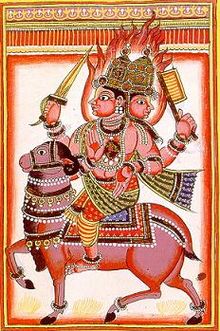
ORIGIN:Hindu [India]
There are many theories about the origins of the god Agni, some tracing it to Indo-European mythologies, others tracing to mythologies within the Indian tradition.
The origin myth found in many Indo-European cultures is one of a bird, or bird like being, that carries or brings fire from the gods to mankind. Alternatively, this messenger brings an elixir of immortality from heaven to earth. In either case, the bird returns everyday with sacrificial offerings for the gods, but sometimes the bird hides or disappears without trace. Agni is molded in similar mythical themes, in some hymns with the phrase the "heavenly bird that flies".
The earliest layers of the Vedic texts of Hinduism, such as section 6.1 of Kathaka Samhita and section 1.8.1 of Maitrayani Samhita state that the universe began with nothing, neither night nor day existed, what existed was just Prajapati (also referred to as Brahman). Agni originated from the forehead of Prajapati, assert these texts. With the creation of Agni came light, and with that were created day and night. Agni, state these Samhitas, is the same as the Brahman, the truth, the eye of the manifested universe. These mythologies develop into more complex stories about Agni's origins in the later layers of Vedic texts, such as in section 2.1.2 of the Taittiriya Brahmana and sections 2.2.3–4 of Shatapatha Brahmana.
Agni is originally conceptualized as the ultimate source of the "creator-maintainer-destroyer" triad, then one of the trinities, as the one who ruled the earth. His twin brother Indra ruled the atmosphere as the god of storm, rain and war, while Surya ruled the sky and heavens. His position and importance evolves over time, in the "creator-maintainer-destroyer" aspects of existence in Hindu thought.
The Shatapatha Brahmana mentions there have been three previous Agnis and current one is the fourth in the series.
TYPE: God of Fire
KNOWN PERIOD OF WORSHIP: Circa 1500 BCE onward and still recognized
SYNONYMS: None
CENTER(S) OF CULT: Known throughout areas of Hindu influence.
ART REFERENCES: Sculptures and reliefs in metal and stone.
LITERARY SOURCES: Rg Veda and other texts.
INFORMATION: God of the sacrificial fire and the intercessor between gods and mankind. Agni is the son of Kasyapa and Aditis or, alternatively, of Dyaus and Prthivi. His consort is Svaha and, according to some texts, he is the father of the god Skanda. In a destructive capacity he is seen as an aspect of the god Siva. He is also a guardian or dikpala of the southeastern quarter. In ancient hymns he is said to have been born in wood as the embryo life force of all trees and plants and he emerges when wood is rubbed together.
Agni (English: AG-nee,romanized: Agni) is a Sanskrit word meaning fire and connotes the Vedic fire deity of Hinduism. He is also the guardian deity of the southeast direction and is typically found in southeast corners of Hindu temples. In the classical cosmology of the Indian religions, Agni as fire is one of the five inert impermanent elements (pañcabhutá) along with space (akasa), water (ap), air (vayu) and earth (prthvi), the five combining to form the empirically perceived material existence (Prakriti).
In Vedic literature, Agni is a major and oft-invoked god along with Indra and Soma. Agni is considered the mouth of the gods and goddesses and the medium that conveys offerings to them in a homa (votive ritual). He is conceptualized in ancient Hindu texts to exist at three levels, on earth as fire, in the atmosphere as lightning, and in the sky as the sun. This triple presence accords him as the messenger between the deities and human beings in the Vedic scriptures. The relative importance of Agni declined in the post-Vedic era, as he was internalised and his identity evolved to metaphorically represent all transformative energy and knowledge in the Upanishads and later Hindu literature. Agni remains an integral part of Hindu traditions, such as being the central witness of the rite-of-passage ritual in traditional Hindu weddings called Saptapadi or Agnipradakshinam (seven steps and mutual vows), in the Upanayana ceremony of rite of passage, as well being part of the diya (lamp) in festivals such as Deepavali and Aarti in Puja.
Agni (Pali: Aggi) is a term that appears extensively in Buddhist texts and in the literature related to the Senika heresy debate within the Buddhist traditions. In the ancient Jainism thought, Agni (fire) contains soul and fire-bodied beings, additionally appears as Agni-kumara or "fire princes" in its theory of rebirth and a class of reincarnated beings and is discussed in its texts with the equivalent term Tejas.
VEHICLE: A she-goat, or a chariot drawn by red horses or parrots.
COLOR: Red
ATTRIBUTES: Seven arms and sometimes the head of agoat, carry a wide variety of objects.
AFFILIATION: Deva, Dikpala
ABODE: Agniloka
WEAPON: Agneyastra
MOUNT: Urial
PARENTS: Brahma
CONSORT: Svaha
CHILDREN: Pavaka, Pavamana, Shuchi, Nila (Ramayana)
ETYMOLOGY, MEANING AND OTHER NAMES: (Agni) continues one of two core terms for fire reconstructed to Proto-Indo-European, other reflexes of which include Latin ignis (the root of English ignite), Lithuanian ugnis, Old Slavonian (ogni) and its descendants: Russian (ogon'), Serbian oganj, Polish ogien, etc., all meaning "fire".
The ancient Indian grammarians variously derived it:
TEXTS:
Vedas: In the Vedic pantheon, Agni occupies, after Indra, the most important position. Agni is prominent in the hymns of the Vedas and particularly the Brahmanas. In the Rigveda there are over 200 hymns that praise Agni. His name or synonyms appear in nearly a third of 1,028 hymns in the Rigveda. The Rigveda opens with a hymn inviting Agni, who is then addressed later in the hymn as the guardian of Rta (Dharma).
The Vedas describe the parents of Agni as two kindling fire sticks, whose loving action creates him. Just born, he is poetically presented as a tender baby, who needs loving attention lest he vanishes. With care, he sparks and smokes, then flames and grows stronger than his parents, finally so strong that he devours what created him.
The hymns in these ancient texts refer to Agni with numerous epithets and synonyms, such as Jatavedas (he who knows all generations), Vaisvanara (relating to all men), Tanunapat (son of himself, self-made), Narasamsa (who embodies men's praise), Tripatsya (with three dwellings), and many others. In Vedic mythologies, Agni is also presented as one who is mysterious with a tendency to play hide and seek, not just with humans but with the gods. He hides in strange places such as waters where in one myth he imbues life force into living beings that dwell therein, and in another where the fishes report his presence to the gods.
Agni is in hymn 10.124 of the Rigveda, a Rishi (sage-poet-composer) and along with Indra and Surya makes up the Vedic triad of deities.
Agni is considered equivalent to and henotheistically identified with all the gods in the Vedic thought, which formed the foundation for the various non-dualistic and monistic theologies of Hinduism. These theme of equivalence is repeatedly presented in the Vedas, such as with the following words in the Mandala 1 of the Rigveda:
MYTHOLOGIES: A sage of the Rig Veda (Sukta IV.iii.11) states that the Sun became visible when Agni was born.
Epics: Offended by Agni, Bhrigu had cursed Agni to become the devourer of all things on this earth, but Brahma modified that curse and made Agni the purifier of all things he touched.
In the "Khandava-daha Parva" (Mahabharata CCXXV), Agni in disguise approaches Krishna and Arjuna seeking sufficient food for gratification of his hunger; and on being asked about the kind of food which would gratify, Agni expressed the desire to consume the forest of Khandava protected by Indra for the sake of Takshaka, the chief of the Nagas. Aided by Krishna and Arjuna, Agni consumes the Khandava Forest, which burnt for fifteen days, sparing only Aswasena, Maya, and the four birds called sarangakas; later, as a boon Arjuna got all his weapons from Indra and also the bow, Gandiva, from Varuna.
There is the story about King Shibi who was tested by Agni assuming the form of a pigeon and by Indra assuming the form of a hawk; Shibi offered his own flesh to the hawk in exchange of pigeon's life. The pigeon which had sought Shibi's shelter was thus saved by the king's sacrifice.
Agnipariksha or 'the Fire test' has Agni as the witness. In the Ramayana, Sita voluntarily goes through this ordeal to prove her virtue.
Puranas: Agni is the eldest son of Brahma. In the Visnu Purana, Agni, called Abhimani is said to have sprung from the mouth of the Virat purusha, the Cosmic Man. In another version, Agni emerged from the ritual fire produced by the wife of Dharma (eternal law) named Vasubharya (literally, "daughter of Light").
According to the Puranic mythology, Agni married Svaha (invocation offering) and fathered three sons – Pavaka (purifier), Pavamana (purifying) and Suchi (purity). From these sons, he has forty-five grandchildren which are symbolic names of different aspects of a fire.[117][118] In some texts, Medha (intelligence) is Agni's sister.
RELATIONSHIPS:
Wife and Children:
Goddess Svaha is Agni's wife. Her name is pronounced with offerings such as butter and seeds poured into the fire during ceremonies. However, like many names in Hindu traditions, the name Svaha embeds symbolic meanings, through its relationship with the Vedic word Svadha found in the hymns of the Rigveda. Thomas Coburn states that the term Svadha refers to "one's own particular nature or inclination", and the secondary sense of "a customary pleasure or enjoyment, a refreshment that nourishes". Svaha is also found in the hymns of the Vedic literature, in the sense of "welcome, praise to you". This salutation is a remembrance of Agni, as an aspect of that which is "the source of all beings". As a goddess and wife of Agni, Svaha represents this Shakti.
In the text Devi Mahatmya of the goddess tradition of Hinduism (Shaktism), and in the Hindu mythologies, Svaha is the daughter of Daksha, Svaha has a crush for Agni. She seduces him by successively impersonating six of seven women at a gurukul (school) that Agni desired for, and thus with him has a baby who grows to become god Skanda – the god of war. Other chapters suggest he was the son of the god Shiva.
The Mahabharata also mentions that when Agni was residing at Mahishmati he fell in love with the daughter of king Nila. In the guise of a Brahmana, he asked for the hand of the princess, but the king refused and was about to punish him. Agni revealed his true form and flamed up in wrath. The frightened king apologized and bestowed his daughter on Agni. In return, Agni promised protection of the city during any invasion.